Leaders need to look two layers down to understand what’s really driving performance
There’s a version of leadership that looks fine on paper.
The work’s getting done. Deadlines are being met, no one’s setting off alarms. If you were reporting up the chain, you’d probably say, “We’re doing alright.”
But sit in the room for long enough and something feels… off.
Conversations feel thinner than they used to. Energy is flatter. People respond, but they don’t really lean in. It’s not burnout. It’s not the kind of disengagement that shows up in a six monthly survey. It’s quieter than that.
People are still here, they’ve just stepped back a little.
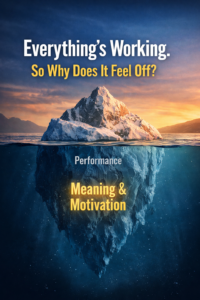
Most leaders are trained to look at what’s visible. Performance, behaviour, output. That’s what shows up, so that’s what gets managed.
The problem is, what’s visible is usually the last thing to change.
By the time performance drops, whatever caused it has been sitting underneath for a while. You just couldn’t see it yet.
That’s where I keep coming back to a simple model I use in my work.
The Everyday Leadership 2×2.
It looks at two things at once.
- What’s happening on the surface, and what’s happening underneath.
- And then, what’s happening right now, and where things are heading next.
Most leaders spend their time in one space: surface level, right now. What’s the issue? What do we need to fix? What action do we take?
Nothing wrong with that. Until it stops working.
Because underneath that surface, something else is going on.
When I talk about going “two layers down”, I’m talking about what’s driving behaviour, not just what’s showing up. Things like beliefs, past experiences, emotional drivers.
But there’s one piece that’s becoming harder to ignore.
Meaning.
Not the big, philosophical kind. The everyday version. Does this still matter to me? Do I feel connected to what I’m doing? Is there a point to pushing here?
When meaning starts to drop away, something subtle happens. People don’t necessarily stop performing, they just stop investing.
This is the trap a lot of teams fall into. On the surface, everything still works.
- The numbers hold.
- The work gets done.
- The system keeps moving.
So the natural conclusion is, “We’re fine.”
Meanwhile, underneath, something is shifting.
- Creativity drops.
- Initiative fades.
- Risk-taking disappears.
- Conversations get safer, and usually shorter.
No big blow-up or dramatic moment. Just a slow drift.
People are still doing the job. They’re just not really in it anymore.
Most leaders don’t ignore this on purpose. It just doesn’t show up in the places they’re used to looking.
It shows up in smaller moments. A team member who used to speak up but now stays quiet, a conversation that feels more transactional than engaged. A decision that gets delayed instead of challenged.
Nothing you can easily measure. But you’ll notice it if you’re paying attention.
This is why the 2×2 matters.
It’s a reminder not to confuse visible performance with what’s actually going on underneath. If you stay at the surface, you’ll keep trying to fix behaviour and output, when the real shift is happening somewhere else entirely.
Underneath it all sits meaning. And meaning fuels energy. It drives creativity. It’s what makes someone lean in rather than just get through the day.
When that starts to slip, everything still works… just not as well as it could.
So instead of asking, “What’s the issue here?” try asking a different question.
Where has the meaning dropped away?
Or even more directly, where are people still doing the work, but not really in it anymore?
That question tends to change the conversation pretty quickly.
This isn’t about becoming more complex as a leader. It’s actually the opposite.
It’s about noticing the small shifts. When energy changes. When people pull back. When conversations lose a bit of depth.
And not brushing it off as “they’re just busy” or “it’s just a phase.”
Sometimes it is. Sometimes it isn’t.
And the moment you notice the difference is usually the moment that matters.
If there’s one shift I’d offer, it’s this.
Leadership isn’t just about driving action. It’s about noticing when people stop caring enough to act.
Because most teams don’t fall apart overnight.
They drift. Quietly. Gradually. While everything still looks fine.
The leaders who make the biggest difference are the ones who notice that drift early… and are willing to go two layers down, before it ever shows up on the surface.